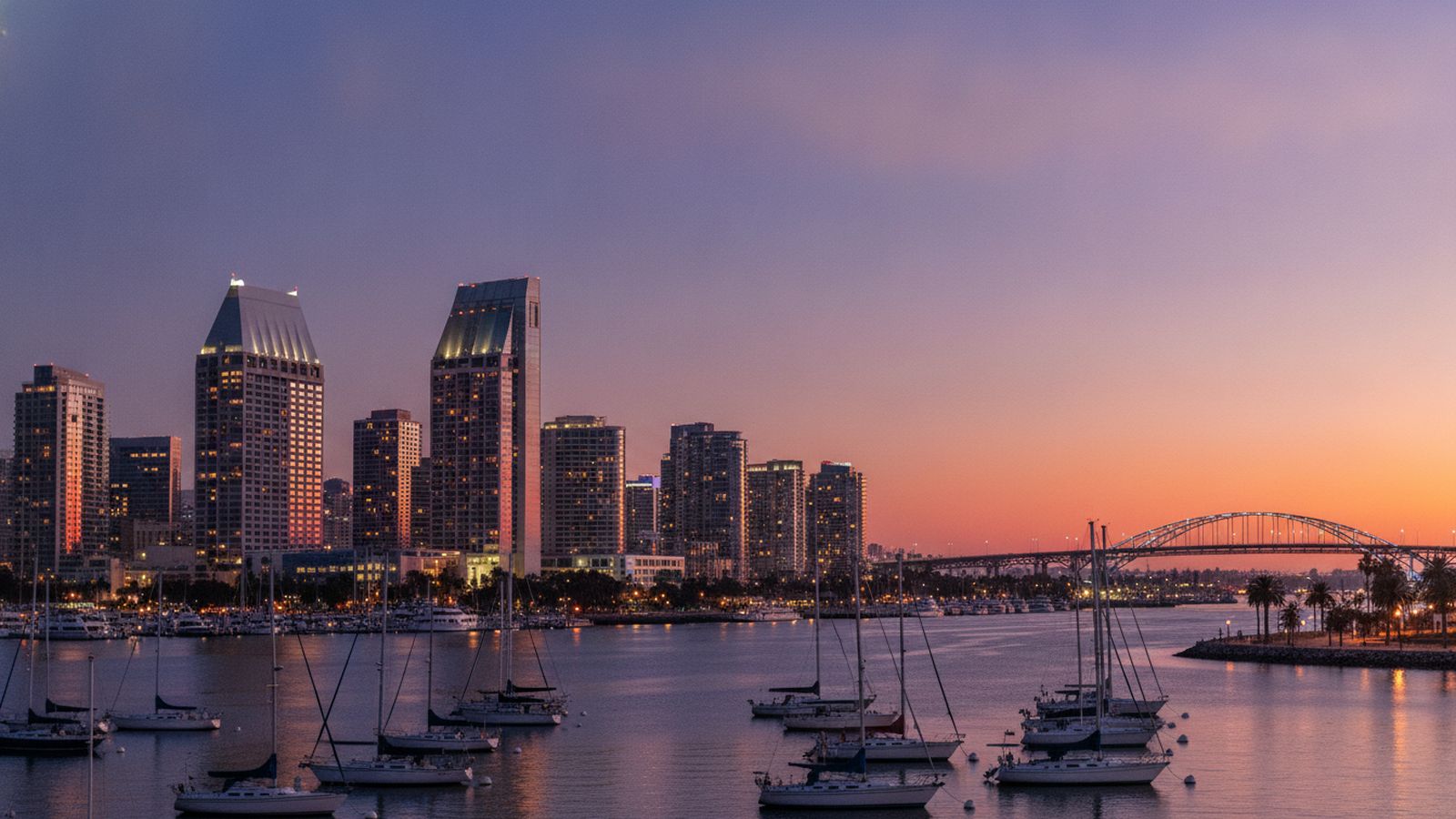
Downtown San Diego occupies the street grid bounded by San Diego Bay on the west and south and Interstate 5 on the north and east. Alonzo Horton bought the land in 1867 and laid out the New Town that became the city's commercial center. For most of the twentieth century few people lived downtown, but redevelopment that began with Horton Plaza in 1985 and the Gaslamp Quarter restoration, followed by Petco Park in 2004, brought waves of residential towers. Today downtown housing is almost entirely multifamily, divided among districts such as the Marina, Cortez Hill, Columbia and East Village.
Housing in Downtown San Diego
Condominiums make up nearly all owner-occupied housing downtown. In the Marina district, low-rise and mid-rise developments built in the 1980s and 1990s are common, often with townhome-style units arranged around inner courtyards. Steel and concrete towers from the 2000s and later line Harbor Drive, Pacific Highway and the blocks around Petco Park, with units ranging from studios under 600 square feet to full-floor penthouses. East Village pairs newer towers with converted warehouse lofts that carry exposed brick, high ceilings and live-work zoning. Cortez Hill has some of the oldest residential buildings, including early twentieth century apartment hotels converted to condominiums. Detached houses are almost nonexistent, and parking spaces and storage units are often deeded separately from the unit.
What shifts value here
Floor level, view direction and the permanence of that view drive most of the price spread inside a single tower. A bay or Coronado view facing west or south commands a premium, while units looking onto an alley or a vacant lot slated for construction trade at a discount. Monthly HOA dues run high because buildings fund concierge staff, pools, elevators and reserves, and very high dues narrow the buyer pool. Special assessments for facade, plumbing or elevator repairs weigh on value until paid. Units near Petco Park and the Gaslamp nightlife absorb event noise. Rental restrictions, the share of short-term rentals and the building's master insurance situation also influence what buyers will pay.
Neighborhoods
- Marina District
- East Village
- Gaslamp Quarter
- Cortez Hill
- Columbia
- Core
Landmarks
- Petco Park
- Seaport Village
- USS Midway Museum
- San Diego Convention Center
- Waterfront Park
Valuation approach
Comparable selection starts inside the same building, since recent sales there share the HOA, amenities, construction quality and parking structure. When in-building sales are thin, the next choice is a competing tower of similar age and height within the same district. Adjustments typically address floor level, view orientation, number of deeded parking spaces and interior upgrades. Owners should provide the current HOA budget, reserve study, any notice of special assessment, recent board minutes and the unit's parking and storage deed descriptions. For a date-of-death value, the building's status on that date matters, including pending litigation or assessments not yet disclosed to buyers.
Local question
How does a pending special assessment in a downtown San Diego tower affect a trust valuation?
If the assessment was approved or formally noticed before the effective date, an appraiser treats it as a known condition that buyers would have discounted. Comparable sales from the same building are reviewed to see whether they closed before or after the assessment was announced, and adjustments reflect the unit's share of the cost. Board minutes and the HOA's assessment notice document the timing, which can matter in trust and estate disputes.
ZIP codes: 92101